
Diana Ozon
author
Diana Ozon (born Diana Groenveld) is a Dutch poet, author, and performance artist. She became a significant figure in the Amsterdam punk movement starting in 1977, where she was known for her role in transforming local landmarks like the Zebrapanden into subcultural hubs. Ozon is recognized as one of the first Dutch punk poets, bridging the gap between youth counterculture and literature. Her work spans poetry, prose, and performance art, often exploring themes of cyberpunk, graffiti, and social commentary. She has published numerous collections of poetry and novels, including 'Laag bij de Gronds' and 'Kraker Jack'.[1,2]
- punk literature
- cyberpunk
- graffiti
- performance art
Diana Ozon: Punk Poetry, Performance, and Early Digital Culture
A sourced introduction to Dutch poet and performer Diana Ozon, tracing her punk-era work, publications, early web activity, and her credited text for Max Natkiel’s *Paradiso Stills*.
Diana Ozon is the pseudonym of Dutch poet Diana Groenveld. Authority data identifies her as born in Amsterdam on 7 August 1959 and connects the name Diana Ozon with Groenveld, the VIAF cluster, ISNI, and a Library of Congress authority identifier (Wikidata). The Digital Library of Dutch Literature (DBNL) likewise lists Diana Ozon as born in Amsterdam in 1959 (DBNL).
Ozon emerged from Amsterdam’s punk and underground culture. The KB, the national library of the Netherlands, describes her as one of the first makers of Dutch punk poetry; it notes that she was active in the squatters’ and underground scene during the 1980s and performed in the Netherlands and abroad (KB). The Theatre Encyclopedia says that she began by publishing poems in her Amsterdam school newspaper, briefly attended the Gerrit Rietveld Academie, and became an important participant in Amsterdam’s punk movement from 1977 (Theatre Encyclopedia). Its account also places her among those involved with the occupied Zebrapanden, where the DDT666 punk club and the editorial centre of Koekrant were housed.
Her writing moved into print alongside this performance-based work. The Theatre Encyclopedia lists Laag bij de Gronds (1982), De Obscure Camera (1983), Hup de Zee (1986), De Ozon Expres (1988), and the novel Kraker Jack (1991), as well as later poetry collections (Theatre Encyclopedia). DBNL records first editions of De Ozon Expres in 1988, Bronwater: gedichten in 2005, and Hartspanne: gedichten in 2009 (DBNL). Its title record identifies Bronwater as a 2005 first edition and a poetry collection (DBNL, Bronwater).
Ozon also has a documented connection to photography through Paradiso Stills (1986). The Theatre Encyclopedia’s bibliography credits the book as a photobook by Max Natkiel with accompanying text by Ozon, published by Fragment (Theatre Encyclopedia). The credit distinguishes her textual contribution from Natkiel’s photographic authorship.
Her interest in language and technology continued into the early web. The KB states that she was closely involved with De Digitale Stad, founded in 1994 as a virtual meeting place for artists, hackers, activists, and other participants, and characterizes her as an early poet exploring poetry on the internet there (KB). ELMCIP’s electronic-literature knowledge base lists two works by Ozon published on the web in 1992: Ascie en Ansie and Compoëzie (ELMCIP).
Taken together, these records show a practice spanning poetry, performance, print, and networked publication. For readers of Paradiso Stills, Ozon’s credited accompanying text is a specific link between her literary work and Natkiel’s photographic book.
Sources
Books
-
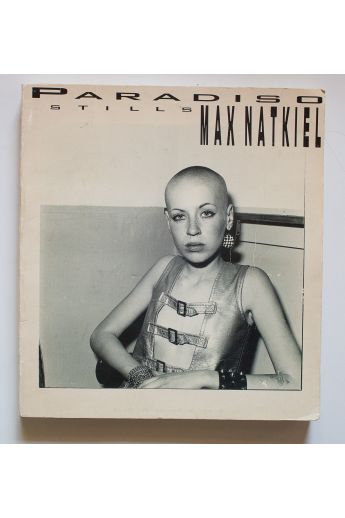 Paradiso Stills€280.00

Works by Diana Ozon
- 1986 Paradiso Stills Accompanying text for Max Natkiel's photobook.
- 1982 Laag bij de Gronds Poetry collection.
- 1983 De Obscure Camera Poetry collection.
- 1986 Hup de Zee Poetry collection.
- 1991 Kraker Jack Novel.