
Garry Winogrand
photographer
Garry Winogrand (1928–1984) was a pioneering American street photographer known for his frenetic and candid documentation of U.S. life in the mid-20th century. Born in the Bronx to Jewish immigrants, he studied painting at City College of New York and Columbia University before pursuing photography. He worked as a freelance photojournalist and advertising photographer in the 1950s and 60s, notably contributing images to 'The Family of Man' exhibition (1955). Winogrand was a central figure in the development of street photography as an attitude and style, influencing generations of photographers with his distinctive framing. He received three Guggenheim Fellowships and a National Endowment for the Arts fellowship. His major monographs include 'The Animals' (1969), 'Women are Beautiful' (1975), and 'Public Relations' (1977). He died in 1984 from gallbladder cancer while seeking alternative treatment in Mexico.[1,2,3,4,5,6,7,8,9,10,11,12,13,14,15,16,17,18,19,20,21,22,23,24,25,26,27,28,29,30,31,32,33,34,35]
- street photography
- American life
- female form
Garry Winogrand: The Restless Grammar of Postwar America
A sourced account of Garry Winogrand’s formation, street practice, landmark books and exhibitions, and the archive that makes his posthumous reputation an ongoing editorial question.
Garry Winogrand (1928–1984) made public spaces in postwar America look crowded, comic, and unsettled. The Library of Congress authority record establishes the authorized form of his name and his dates, while the Center for Creative Photography (CCP) gives his precise dates as 14 January 1928–19 March 1984 and identifies him as a photographer. (Library of Congress; CCP archive)
From painting to photography
Winogrand was born in the Bronx, served briefly in the U.S. Army as a weather forecaster, studied painting at City College in 1947–48 and Columbia University in 1948–51, and studied photography with Alexey Brodovitch at the New School for Social Research in 1951. He subsequently worked for agencies and magazines while making personal work. (International Center of Photography; CCP archive)
The mature photographs are candid observations of daily life, often made with a 35mm camera. ICP notes his visual puns and tilted exposures; CCP records his use of nontraditional camera angles and his rejection of the label “snapshot aesthetic.” Both sources preserve variations of his formulation that he photographed to see what the world—or the things that interested him—looked like in photographs. (International Center of Photography; CCP archive)
A new documentary attitude
Winogrand’s place in American photography was consolidated through a sequence of important exhibitions. ICP records his participation in Edward Steichen’s The Family of Man, Nathan Lyons’s Toward a Social Landscape, and John Szarkowski’s New Documents. MoMA dates New Documents to 28 February–7 May 1967 and names Winogrand alongside Diane Arbus and Lee Friedlander. In Szarkowski’s account, the three redirected documentary photography toward personal ends: their aim was “not to reform life but to know it.” (International Center of Photography; MoMA, New Documents)
A later retrospective at SFMOMA described his postwar America as rich with possibility but close to spinning out of control. It also quotes guest curator Leo Rubinfien on the coexistence in the work of postwar hope and a sense of “undoing.” This formulation is useful because Winogrand’s humor and visual energy do not eliminate unease; they make it visible. (SFMOMA, Garry Winogrand)
Books and public occasions
CCP’s archive contains copies of four books published by Winogrand: The Animals, Women Are Beautiful, Public Relations, and Stock Photographs. Its biographical note says that The Animals (1969) collected photographs made at the Bronx Zoo and Coney Island Aquarium. (CCP archive)
Public Relations grew from Winogrand’s 1969 Guggenheim Fellowship proposal to photograph “the effect of media on events.” MoMA’s 1977 press release records that he worked on the project for several years, photographing marches, rallies, press conferences, games, strikes, demonstrations, parades, award ceremonies, dinners, museum openings, and other public occasions. The MoMA exhibition ran from 18 October to 11 December 1977, and the accompanying book—introduced by Tod Papageorge—had 112 pages and 74 photographs. (MoMA, Public Relations press release)
The linked publication records include The Animals, Women Are Beautiful, Public Relations, Stock Photographs: The Fort Worth Fat Stock Show and Rodeo, Winogrand: Figments from the Real World, and Arrivals and Departures: The Airport Pictures of Garry Winogrand. Several titles occur in more than one record, so their edition histories should be kept distinct rather than treated as a single generic publication.
Beyond New York and the unresolved archive
Although much of Winogrand’s best-known work was made in New York during the 1960s, he worked widely elsewhere. SFMOMA identifies California, Texas, Miami, and Chicago among the places he photographed; the National Gallery of Art’s 2014 retrospective divided the work between New York through 1971, journeys elsewhere in the same period, and a later phase including Texas and Southern California. (SFMOMA, Garry Winogrand; National Gallery of Art retrospective press release)
His posthumous archive remains central to the interpretation of the work. SFMOMA and the National Gallery reported roughly 250,000 frames left exposed but undeveloped or otherwise unedited at his death. CCP’s finding aid describes 420 boxes of photographic material, including negatives, contact sheets, slides, commercial work, posthumous prints, and study and work prints, as well as business, exhibition, printed, and moving-image material. (SFMOMA, Garry Winogrand; CCP archive)
The 2013–15 retrospective, organized by SFMOMA and the National Gallery of Art, traveled to Washington, New York, Paris, and Madrid. The accompanying 2013 catalogue, edited by Leo Rubinfien, has 464 pages and incorporates newly printed photographs alongside well-known work. (SFMOMA, Garry Winogrand; SFMOMA publication) That archival dimension makes a lasting editorial question unavoidable: the difference between exposing film and selecting an authored body of work.
Sources
- Library of Congress Name Authority File
- Center for Creative Photography, Garry Winogrand archive finding aid
- International Center of Photography, Garry Winogrand
- Museum of Modern Art, New Documents
- Museum of Modern Art, Public Relations press release (1977)
- San Francisco Museum of Modern Art, Garry Winogrand
- San Francisco Museum of Modern Art, Garry Winogrand publication
- National Gallery of Art, retrospective press release (2014)
Books
-
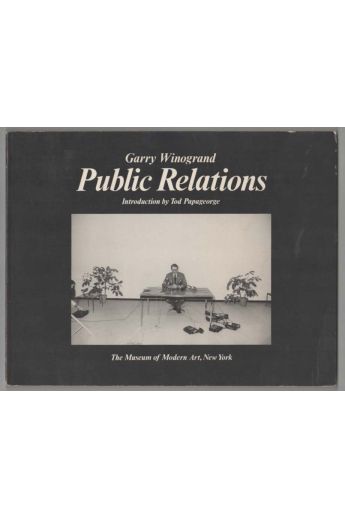 Public relations€56.00
 -
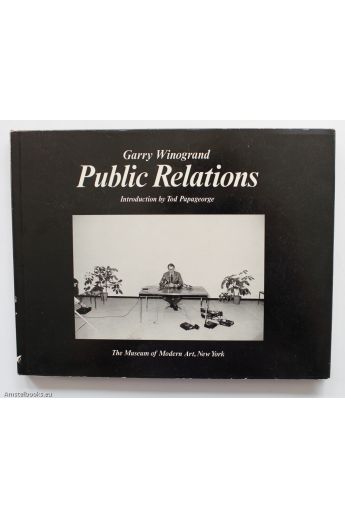 Public Relations€87.00
 -
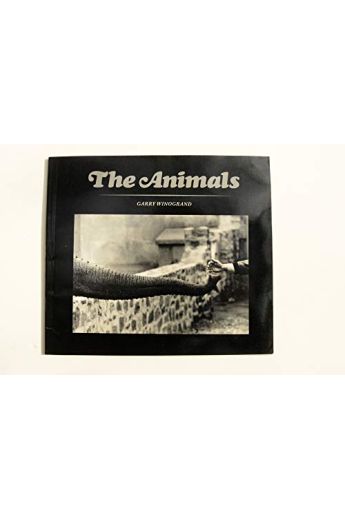 The animals€135.00
 -
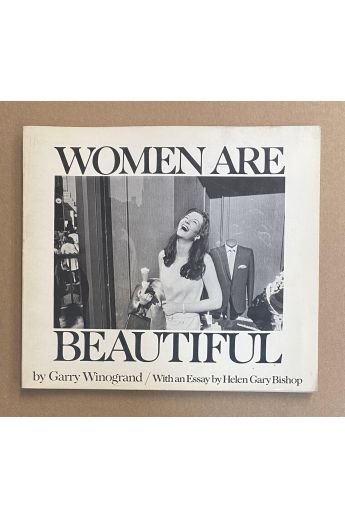 Women Are Beautiful€317.00
 -
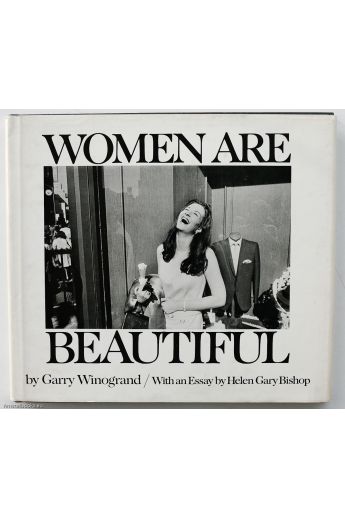 Women Are Beautiful€427.00


Works by Garry Winogrand
- 1969 The Animals
- 1975 Women are Beautiful
- 1977 Public Relations
- 1980 Stock Photographs: The Fort Worth Fat Stock Show and Rodeo
- 1988 Figments from the Real World
- 1998 The Man in the Crowd: The Uneasy Streets of Garry Winogrand
- 2001 El Juego de la Fotografía = The Game of Photography
- 2002 Winogrand 1964: Photographs from the Garry Winograd Archive, Center for Creative Photography, the University of Arizona
- 2004 Arrivals & Departures: The Airport Pictures of Garry Winogrand
- 2013 Garry Winogrand
- 2023 Winogrand Color
Exhibitions
- 1969 The Animals
- 1975 Women are Beautiful
- 1977 Public Relations
- 1979 The Rodeo
- 1979 Greece
- 1980 Garry Winogrand: Retrospective
- 1983 Big Shots, Photographs of Celebrities, 1960–80
- 1984 Garry Winogrand: A Celebration
- 1984 Women are Beautiful
- 1984 Recent Works
- 1986 Twenty Seven Little Known Photographs by Garry Winogrand
- 1988 Garry Winogrand
- 2001 Winogrand's Street Theater
- 2013 Garry Winogrand
- 2014 Garry Winogrand
- 2014 Garry Winogrand
- 2014 Garry Winogrand
- 2019 Garry Winogrand: Color
- 2024 Garry Winogrand: Man of the Crowd
- 1955 The Family of Man
- 1957 Seventy Photographers Look at New York
- 1963 Photography '63
- 1964 The Photographer's Eye
- 1966 Toward a Social Landscape
- 1967 New Documents
- 1970 The Descriptive Tradition: Seven Photographers
- 1971 Seen in Passing
- 1975 14 American Photographers
- 1976 The Great American Rodeo
- 1978 Mirrors and Windows: American Photography since 1960
- 1981 Garry Winogrand, Larry Clark and Arthur Tress
- 1981 Bruce Davidson and Garry Winogrand
- 1980 Central Park Photographs: Lee Friedlander, Tod Papageorge and Garry Winogrand
- 1983 Masters of the Street: Henri Cartier-Bresson, Josef Koudelka, Robert Frank and Garry Winogrand
Awards
- 1964 Guggenheim Fellowship
- 1969 Guggenheim Fellowship
- 1979 Guggenheim Fellowship
- 1975 Fellowship
References
- Andy Grundberg. Garry Winogrand, Innovator in Photography. The New York Times. 1984 link
- The Animals. Museum of Modern Art. 1969 link
- Richard B. Woodward. Garry Winogrand and the Art of the Opening. The Paris Review. 2013 link
- Garry Winogrand. John Simon Guggenheim Memorial Foundation link
- Sean O'Hagan. Garry Winogrand: the restless genius who gave street photography attitude. The Guardian. 2014 link
- Sean O'Hagan. Why street photography is facing a moment of truth. The Observer. 2010 link
- Phil Coomes. The photographic legacy of Garry Winogrand. BBC News. 2013 link
- Andy Greaves. Andy Greaves Photography Blog – Gary Winogrand. 2010 link
- Michael Hoppen Gallery – Garry Winogrand link
- Edward Steichen et al.. The family of man. Museum of Modern Art. 1955 link
- Gerd Hurm et al.. The family of man revisited. I.B.Tauris. 2018 link
- Eric J Sandeen. Picturing an exhibition : the family of man and 1950s America. University of New Mexico Press. 1995 link
- Five Unrelated Photographers. Museum of Modern Art link
- Michael Peres. The Concise Focal Encyclopedia of Photography. CRC Press. 2014 link
- Nathan Lyons. Toward a Social Landscape. Horizon Press. 1966 link
- William Grimes. Nathan Lyons, Influential Photographer and Advocate of the Art, Dies at 86. The New York Times. 2016 link
- Garry Winogrand – Bio link
- Museum of Contemporary Photography. Garry Winogrand link
- Garry Winogrand. Public Relations. Museum of Modern Art. 1977 link
- Winogrand's Women Are Beautiful. Worcester Art Museum link
- O.C. Garza. Class Time with Garry Winogrand link
- Garry Winogrand. Artnet link
- American Suburb X – introduction to Garry Winogrand. 2010 link
- Stock Photographs: The Fort Worth Fat Stock Show and Rodeo. Olympic Marketing Corp. 1980 link
- Frank Van Riper. Washington Post
- Winogrand married his second wife, Judy Teller.
- Judith Teller. 1969
- 1972
- 1984
- 1984
- Garry Winogrand Archive. Center for Creative Photography link
- Garry Winogrand Archive. Center for Creative Photography link
- Leo Rubinfien. 2013
- Judith Teller. 1969
- Phil Coomes. The photographic legacy of Garry Winogrand. BBC News. 2013 link